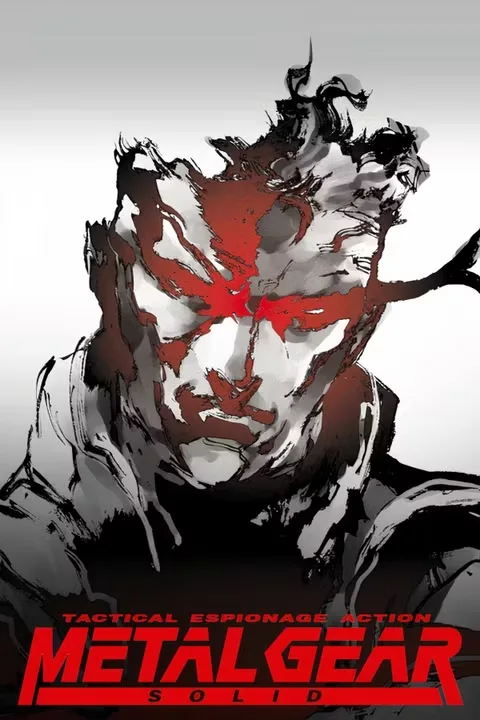
Metal Gear Solid
Metal Gear Solid is a 1998 stealth action game developed by Konami Computer Entertainment Japan and published by Konami. Directed, written, and produced by Hideo Kojima, it was released for PlayStation in Japan on September 3, 1998, and in North America on October 21, 1998. It is the third mainline entry in the Metal Gear series (sequel to the 1990 MSX2 game Metal Gear 2: Solid Snake) and the first to be released outside Japan under the Metal Gear Solid name.
The game received a Metacritic score of 94 and sold over six million copies — the eighth best-selling game in PlayStation’s history. It is credited with making the stealth genre mainstream, establishing cinematic presentation as a viable and desirable mode of game design, and producing the most discussed boss fight of its console generation.
Technical Specifications
| Attribute | Details |
|---|---|
| Developer | Konami Computer Entertainment Japan |
| Publisher | Konami |
| Director / Writer | Hideo Kojima |
| Art Director | Yoji Shinkawa |
| Voice Director | Kris Zimmerman-Salter |
| Composers | Kazuki Muraoka · Hiroyuki Togo · Takanari Ishiyama · Lee Jeon Myung · Gigi Meroni |
| Original Platform | PlayStation |
| Current Platform | PC · PS4 · PS5 · Xbox One · Xbox Series X/S · Nintendo Switch (via Master Collection Vol. 1) |
| Release Date | JP: Sep 3, 1998 · NA: Oct 21, 1998 · EU: Feb 22, 1999 |
| Genre | Stealth, Action-adventure |
| Mode | Single-player |
Shadow Moses: The Mission
Solid Snake — a retired special forces operative, former member of FOXHOUND — is pulled back into service by Colonel Roy Campbell. The mission: infiltrate Shadow Moses, a remote nuclear weapons disposal facility on an Alaskan island, which has been seized by a rogue faction of FOXHOUND. The terrorists have both the facility’s nuclear warheads and Metal Gear REX — a bipedal nuclear-armed walking tank — and are demanding the remains of their legendary commander Big Boss and a billion-dollar ransom.
Snake must rescue two hostages (a DARPA Chief and a weapons developer), disable Metal Gear REX before a nuclear strike can be launched, and survive the FOXHOUND unit standing between him and these objectives. He communicates with his support team — Campbell, medic Naomi Hunter, computer expert Mei Ling, weapons specialist Master Miller — through a radio codec. He encounters another operative on the island: a former comrade turned cybernetic soldier known as Gray Fox.
The antagonist is Liquid Snake: the FOXHOUND commander, who is also Solid Snake’s twin brother. Both are clones of Big Boss, products of a program called Les Enfants Terribles. Liquid believes he received the recessive genetic material and is determined to prove his supremacy. The story the game builds toward is not primarily a nuclear crisis — it is a meditation on nature versus nurture, the costs of a warrior’s life, and whether identity can exist outside of what we inherit.
Kojima’s Cinematic Language
Metal Gear Solid arrived in 1998 at a moment when games’ relationship to cinema was primarily about cutscene technology: FMV sequences stitched between gameplay segments. What Kojima built was something structurally different — a game that used cutscenes not as interludes but as integral to the design, in which character, theme, and plot were developed through extended dramatic sequences that rivalled the length and ambition of television drama.
Snake encounters, fights, and loses to the same antagonists multiple times before the final confrontation. Bosses have backstories delivered through in-game conversations and environmental context. The game’s most dramatic moments — Gray Fox’s last stand, Sniper Wolf’s death in the snow, the final codec call between Snake and a character whose identity reframes the entire game — are presented with staging, performance, and score use that the medium had not previously achieved at this scale.
Hideo Kojima has described cinema as the art form he most wanted to participate in but could not access; Metal Gear Solid is where the game industry first saw what that aspiration produced when applied to an interactive medium.
The Codec: Radio Drama as Character Development
The codec — an in-game radio communication system depicted as a small screen showing the face of the person Snake is speaking to — functions as the game’s primary mode of non-cutscene character development. Snake can contact any of his support team at almost any point in the game. The conversations cover practical information (weapon tips, area tactics) and character development in roughly equal proportion.
The depth of the codec conversations extends well beyond what the main story requires. Campbell discusses his history with Snake. Mei Ling cites proverbs from Chinese literature after every save and engages in extended conversations that have nothing to do with the mission. Naomi Hunter’s emotional stake in the operation gradually reveals itself. Miller, who appears in the early game as a warm presence and survival expert, has a story whose significance is disclosed through the player’s attention to what changes about his calls as the game progresses.
This approach — character development delivered through voluntary optional contact rather than scripted scenes — was absorbed into the design DNA of games as different as Mass Effect‘s companion conversations and Death Stranding‘s idle chatter. In 1998, it was unprecedented.
Boss Encounters
Metal Gear Solid‘s boss roster is among the most characterised in gaming history, each FOXHOUND member given a backstory, a motivation, and a design concept that Yoji Shinkawa’s art realized in immediately memorable form:
Psycho Mantis is the most famous. The telepathic FOXHOUND member can read the player’s PlayStation memory card and comment on other Konami games saved on it. He opens the fight by demonstrating his power to “read your mind” by making the DualShock controller vibrate. He cannot be defeated while the controller is plugged into port 1 — his power reads your inputs — and can only be overcome by physically unplugging the controller and inserting it into port 2, removing him from the connection. He is the first major instance of a video game boss defeating a game mechanic as part of his design, and he is still cited as the creative benchmark for the category twenty-eight years later.
Sniper Wolf is an Iraqi-Kurdish sniper whose personal history as a child soldier gives their two encounters a weight that the encounter design earns by requiring the player to endure a sustained sniper duel before reaching her. Her death scene — in the snow, asking Snake to pull the trigger — is among the most discussed boss deaths in the game’s generation.
Gray Fox (the Cyborg Ninja) is Solid Snake’s former partner Frank Jaeger, now a cybernetically augmented warrior who appears first as an antagonist and reveals himself gradually as something more complicated. His final appearance is structurally the game’s emotional centre and deliberately evokes the relationship between two soldiers who have spent their careers across from each other in ways they cannot fully reconcile.
The Fourth Wall
Metal Gear Solid is the origin point for several of the most reproduced fourth-wall-breaking moments in gaming:
- The codec frequency for the character Meryl is not given in-game. Snake says “I don’t know that codec number — but it might be on the back of the CD case.” The frequency is printed on the back of the physical game’s jewel case.
- The save screen (in the PC version, where there is no memory card to consult) changes the game’s texture in ways that demonstrate Psycho Mantis has accessed the game’s data.
- Ocelot’s reference during the torture sequence to being the one who “will torture you” is also the game’s mechanic for delivering this experience to the player: the player endures a timed button-mashing sequence that determines whether Meryl lives or dies.
These moments exist in a specific category of design where the game acknowledges what it is — a video game, played on a specific console, stored on a disc, controlled by a specific input device — and uses that acknowledgment as a narrative and mechanical instrument.
The Story: Context and Complexity
The Reddit thread “Can someone explain the story of Metal Gear — tell me everything” draws over 3,000 monthly organic visitors, which reflects a real phenomenon: Metal Gear Solid‘s narrative is the entry point to a franchise whose lore accumulates over five mainline numbered entries across two decades.
For the first game specifically, the story is more contained than the series subsequently becomes. The significant reveals — that Liquid Snake is also a Big Boss clone, that Master Miller has not been who he appeared to be in the codec calls, that Snake has been carrying a genetic weapon in his body — are delivered clearly within the game and do not require knowledge of Metal Gear 2: Solid Snake to land. The game begins a thread about the nature of Big Boss, the Patriots (an organisation referenced but not explained), and the question of whether Solid Snake’s fate is determined by genetics, which the subsequent games spend enormous effort addressing.
Playing MGS1 before its sequels is the recommended order. The series’ chronological order (placing MGS3 first, then Portable Ops, Peace Walker, Ground Zeroes, The Phantom Pain, then MGS1, MGS2, MGS4) is sometimes suggested but produces a significantly more complicated first encounter with the franchise.
Yoji Shinkawa
The visual identity of Metal Gear Solid is inseparable from the work of Yoji Shinkawa, the character and mechanical designer whose angular, expressionistic illustration style defined how the series looked from the first game through Konami’s split with Kojima in 2015. Shinkawa continued working with Kojima at Kojima Productions: his designs populate Death Stranding with the same combination of precision silhouette and implied movement.
In the first Metal Gear Solid, Shinkawa’s work transformed what were described as “supernatural soldiers with unusual abilities” — the FOXHOUND unit — into one of the most visually cohesive antagonist ensembles in gaming. Psycho Mantis’s gas mask, Sniper Wolf’s white cloak, the Cyborg Ninja’s faceted helmet: these images remain immediately recognisable to anyone who played the game, and they carry the series’ identity in a way that the story summaries and mechanics descriptions cannot fully replicate.
Current Availability: Master Collection Vol. 1
Metal Gear Solid is currently available as part of Metal Gear Solid: Master Collection Vol. 1 (October 24, 2023), published by Konami for PS4, PS5, Xbox One, Xbox Series X/S, Nintendo Switch, and PC (Steam). The collection includes MGS1, MGS2 (Sons of Liberty), MGS3 (Snake Eater), and the original MSX2 games (Metal Gear and Metal Gear 2: Solid Snake).
The Master Collection’s technical implementation received mixed reviews on PC — frame rate limitations, limited display options, and performance inconsistencies in the PS3-era emulation used for MGS2 and MGS3 were specific complaints. The MGS1 component, running as an emulated PS1 game, was generally considered stable. GOG also offers a standalone PC version of MGS1. The physical Nintendo Switch, PS4, and PS5 versions received the most broadly positive reception for stability.
MGS3 Delta: The Franchise in 2026
The most actively searched piece of Metal Gear content in the current SERP is not MGS1 but Metal Gear Solid 3: Snake Eater — specifically its announced remake, Metal Gear Solid Δ: Snake Eater (read as “Delta”). Announced at Sony’s PlayStation Showcase in 2023, developed by Konami with external production support, the remake is confirmed for PS5, Xbox Series X/S, and PC. As of June 2026, no release date has been announced, and the project has released limited promotional material since announcement. The @Metalgear official account’s recent social activity in the SERP suggests marketing activity is ongoing.
Reception
Metal Gear Solid received a Metacritic score of 94 and a BAFTA Interactive Entertainment Award in 1999. Critics cited the cinematic presentation, the boss design, the voice acting, and the depth of optional conversation as unprecedented for the platform. GameSpot gave it a 9.8/10. IGN gave it a 9.4/10. It was the first time a stealth game had achieved that level of mainstream recognition.
Commercially, the game shipped over six million copies and was one of the primary titles cited in analyses of the PlayStation’s dominance of the late 1990s console market. David Hayter’s voice performance as Solid Snake became the reference point for the gruff action game protagonist voice archetype for the following decade, and Cam Clarke’s Liquid Snake — measured, aristocratic, increasingly unhinged — represents the most quoted villain performance in the series.