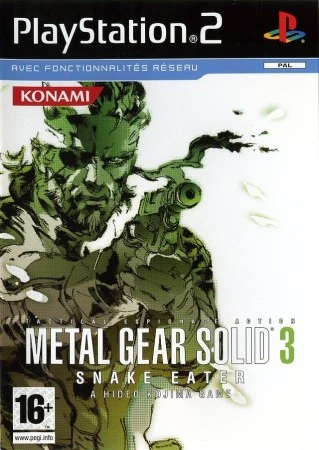
Metal Gear Solid 3: Snake Eater
Metal Gear Solid 3: Snake Eater is a 2004 stealth action game developed by Konami Computer Entertainment Japan and published by Konami. Directed and written by Hideo Kojima, it was released for PlayStation 2 in Japan and North America on November 17, 2004. It received a Metacritic score of 91 and is widely regarded — including by many of the franchise’s most dedicated players — as the finest game in the Metal Gear series.
A full remake, Metal Gear Solid Δ: Snake Eater (pronounced “Delta”), was released on August 28, 2025, for PlayStation 5, Xbox Series X/S, and PC, developed by Konami in partnership with Virtuos (the Singapore-based studio that also co-developed Oblivion Remastered) and built on Unreal Engine 5. It received a Metacritic score of 86 and sold over one million copies in its first week.
Technical Specifications
| Original (2004) | Delta (2025) | |
|---|---|---|
| Developer | Konami Computer Entertainment Japan | Konami / Virtuos |
| Publisher | Konami | Konami |
| Director | Hideo Kojima | Konami (various) |
| Composers | Harry Gregson-Williams · Norihiko Hibino | Harry Gregson-Williams · Norihiko Hibino (preserved) |
| Engine | Modified PS2 engine | Unreal Engine 5 |
| Platform(s) | PlayStation 2 | PS5 · Xbox Series X/S · PC |
| Release | November 17, 2004 (NA) | August 28, 2025 |
| Genre | Stealth, Action-adventure | Stealth, Action-adventure |
| Metacritic | 91 | 86 |
The original is also available via Master Collection Vol. 1 (2023) on PC, PS4, PS5, Xbox, and Nintendo Switch.
1964: The Cold War Setting
Snake Eater is a radical departure from its two predecessors in setting, tone, and protagonist. Where Metal Gear Solid (1998) and Sons of Liberty (2001) took place in near-future environments saturated with technology and institutional dread, Snake Eater is set in the Soviet Union jungle in August 1964 — the era of the Cold War, a year after the Cuban Missile Crisis, when the world had just learned how close it had come to nuclear annihilation and had not yet processed what that meant.
The game opens with a black-and-white James Bond-style title sequence — complete with silhouettes, gunshots, and the theme song “Snake Eater” performed by Cynthia Harrell — that announces its genre reference point immediately. It is a spy thriller in the Bond tradition, not a near-future action game. The jungle, the KGB, the GRU, Cold War nuclear politics, and the specific tragedy of two superpowers destroying individual people for national interest: these are the game’s operating materials.
Naked Snake and the Origin of Big Boss
The protagonist is Naked Snake (voiced by David Hayter in the original English version), designated as such before the events of the game elevate him to the legendary status the player of the previous games already knows. He is a CIA operative and protégé of the legendary soldier The Boss, sent into Soviet territory to rescue a defecting scientist, Nikolai Stepanovich Sokolov, and extract him before the Soviet military can use him to complete the Shagohod — a nuclear-armed prototype vehicle with strategic strike capability.
The mission goes wrong almost immediately. The Boss, Snake’s mentor and the greatest soldier alive, appears to defect to the Soviet officer Colonel Volgin, handing him American nuclear weapons and betraying the United States. The resulting nuclear incident forces a mission change: Snake must return to the jungle, destroy the Shagohod, recover the stolen weapons, and kill The Boss. His country will disavow him if he fails.
The player knows, from Metal Gear Solid and its predecessors in the franchise, who Naked Snake becomes: Big Boss, the legendary soldier whose genetics produced Solid Snake, Liquid Snake, and the entire architecture of the later games’ conflicts. Snake Eater is the story of how that transformation happened — and what it cost.
The Boss: The Game’s True Protagonist
The Boss is one of the great characters in the medium’s history and the game’s emotional centre, despite spending most of the narrative as an antagonist. She is the founder of modern special forces, the creator of CQC (Close Quarters Combat), the person who trained Naked Snake in everything he knows, and the person he must kill to complete his mission.
The game’s most significant revelation is withheld until the final moments: The Boss never defected. The United States government issued her a suicide mission — infiltrate Colonel Volgin’s operation, steal the nuclear weapons he had already obtained through other means, and allow the nuclear strike on Sokolov’s facility to be attributed to her as a rogue American traitor. Her “defection” was always the mission. She knew Snake would be sent to kill her. She accepted it as the final and ultimate act of her patriotism, sacrificing not just her life but her legacy — her name would forever be that of a traitor rather than the hero she was.
Snake kills her. He receives the title “Big Boss” — the highest honour the United States can confer on a soldier. He walks away from the ceremony alone. The game ends.
The trajectory of the entire Metal Gear franchise, across five subsequent games, flows from this moment and what it does to the man who survived it.
Jungle Survival: Camouflage, Stamina, and Injuries
Snake Eater introduced three interlocking survival systems that differentiated its play from the previous games:
Camouflage: The jungle provides cover, but only if the player’s outfit and face paint match the environment. Players select camo patterns from a catalogue — bark, leaves, tiger stripe, solid colours — and the game calculates a camo index percentage that determines how visible Snake is to enemies at any distance. The right pattern in the right environment makes Snake nearly invisible while stationary; the wrong one makes him conspicuous regardless of position. Changing camo requires pausing the game and accessing the inventory, which is itself a strategic decision during infiltration.
Stamina and Food: Snake’s stamina depletes over time and more quickly when running, fighting, or using abilities. Eating food replenishes it. Food is obtained by hunting: snakes, frogs, rats, river fish, birds, and various other jungle fauna that can be captured, shot, or simply found dead. Different animals provide different stamina values, and some — venomous snakes, centipedes — damage Snake if not handled correctly. The system makes exploration rewarding and gives the jungle ecology a functional relationship to survival rather than pure atmosphere.
Injury Treatment: Being shot, slashed, burned, or bitten causes specific types of damage that require specific treatments. Bullets must be removed with forceps before bandaging. Snake bite requires antidote. Burns need ointment. Broken bones need splints. The treatment menu is accessed manually and takes real time, creating brief windows of vulnerability and a persistent management layer that connects combat consequences to the player’s resource management.
Key Encounters
The End is the most celebrated boss fight in Metal Gear Solid 3, and one of the most celebrated in gaming. He is an ancient master sniper — so old his body photosynthesises sunlight — who has come out of retirement for this final mission. The fight takes place across three large jungle map sections. The End can be anywhere. He watches, waits, repositions, and fires from positions the player must locate through sound, footprint tracking, and careful observation. The fight can last several real-world hours if the player engages carefully. It can be ended in seconds if the player shoots him during a cutscene before the fight begins. It can be skipped entirely if the console’s clock is set forward several weeks and the player loads the save — The End will have died of old age.
The Sorrow is a mandatory encounter with a dead man. The player must wade through a river, and every enemy Snake has killed throughout the game appears as a ghost in its depths — the more lethal the playthrough, the longer and more densely populated the river. Players who killed no one find a short, peaceful crossing. Players who killed hundreds find an extended ordeal of the faces of people they shot.
The Boss requires no mechanical preparation. She is the greatest CQC practitioner alive and fights with a calm, measured precision that communicates who she is as cleanly as her dialogue has. The fight is not about defeating an enemy. The game knows it, and so does Snake.
Snake Eater: The Song
The title song “Snake Eater“, written by Harry Gregson-Williams and performed by Cynthia Harrell, was composed as an explicit homage to the James Bond title theme tradition — the bold brass, the torch-singer voice, the deliberately absurd lyrics about eating snakes and surviving and love. It was Harrell’s first major recording credit. The song plays over the game’s opening title sequence (the aforementioned Bond-parody silhouette animation), and it plays again, in full, over the game’s final credits sequence — the only time in the franchise a song receives this double placement, and the choice retroactively charges the absurd lyrics with everything the player has just experienced.
The song has been performed by the Zurich Chamber Orchestra, appeared on orchestral video game music compilation albums, and is consistently cited as one of the most memorable pieces of original music in the medium’s history.
Metal Gear Solid Δ: Snake Eater
The 2025 remake rebuilds Snake Eater in Unreal Engine 5, preserving all of the original’s content — story, cutscenes, mission structure, boss encounters, survival mechanics — while completely replacing the visual presentation and offering both a modernised control scheme and an option to play in the original’s style.
“New Style” controls adopt the over-the-shoulder camera and more fluid aiming of Metal Gear Solid V: The Phantom Pain (2015), making the game significantly more mechanically accessible for players coming from later action games. “Legacy Style” controls replicate the fixed overhead camera of the original — which produces a meaningfully harder game, since the overhead perspective obscures exactly the kind of information that modern over-the-shoulder cameras provide. The option to toggle between these modes at any time was received as a thoughtful accommodation of both returning players and newcomers.
The UE5 presentation updates every environment, character, and cutscene to a photo-realistic rendering standard that sits alongside the best-looking games of 2025 while preserving the original’s compositions and staging. The cutscenes, rebuilt rather than simply upscaled, retain the exact dialogue and direction of the 2004 originals.
The “Snake vs. Monkey” mini-game — a comedic mode from the original Subsistence in which Snake hunts the apes from Konami’s Ape Escape — was included, a detail that was greeted warmly by the community as evidence of Konami’s fidelity to the complete original experience.
Criticisms focused on: occasional performance issues (hair rendering, reflections, cutscene stuttering); the absence of a minimap; loading screens between zones that felt anachronistic for a 2025 production; and the perception that the New Style controls made the game too easy. The optional top-down camera specifically addresses the difficulty concern by deliberately reproducing the visibility limitation of the original.
Metacritic settled at 86 across platforms. OpenCritic gave it 87 with a “Mighty” rating and 96% recommendation rate from initial critics. GameSpot, Shacknews, and Game Informer scored it 9/10; IGN 8/10; GamingBolt 10/10. The r/metalgearsolid thread “A newbie’s thoughts on Metal Gear Solid 3: Snake Eater,” posted shortly after Delta’s release and reflecting first impressions of the remake, currently draws 6,030 monthly visitors — the third-highest organic result for the game in search.
Reception
Metal Gear Solid 3: Snake Eater (2004) received a Metacritic score of 91 and is frequently cited as the definitive entry in the franchise in fan and critical surveys. Its sustained reputation as the emotionally strongest Metal Gear game has not fluctuated in twenty years. The Virtuos-developed remake represents the most accessible version of the game currently available and, for the community, the recommended entry point for players discovering the franchise in 2026.