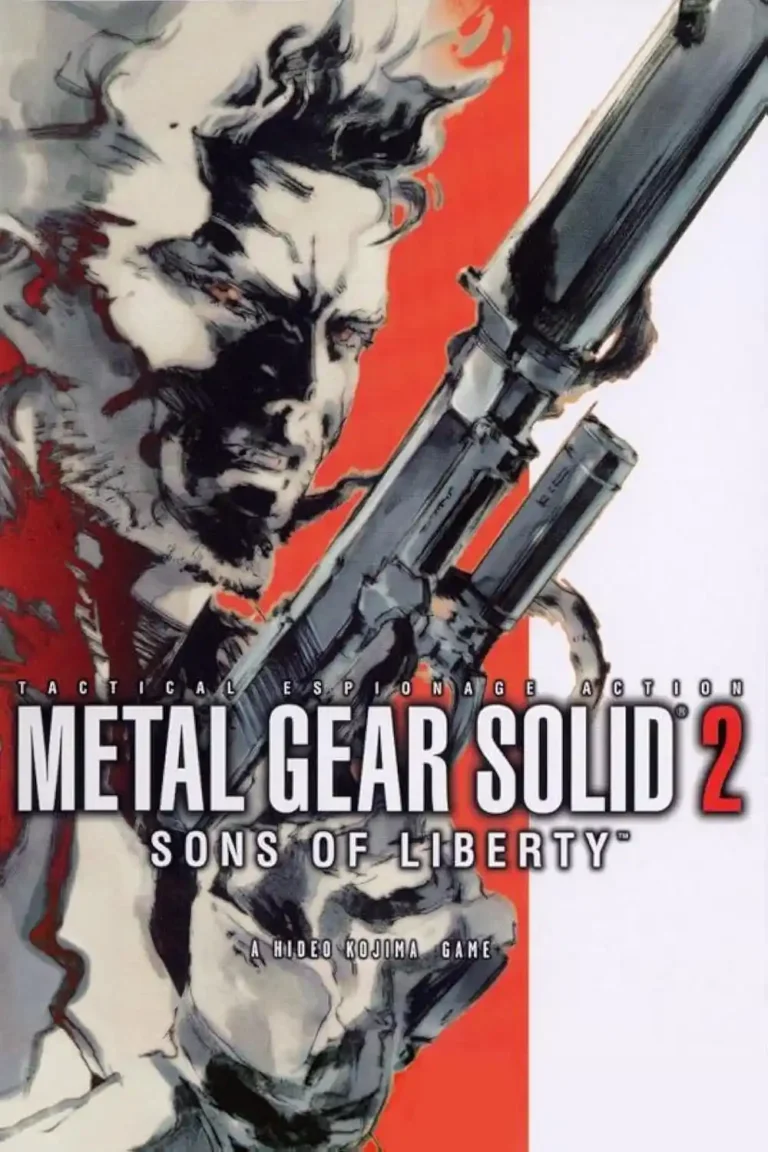
Metal Gear Solid 2: Sons of Liberty
Metal Gear Solid 2: Sons of Liberty is a 2001 stealth action game developed by Konami Computer Entertainment Japan and published by Konami. Directed and written by Hideo Kojima, it was released for PlayStation 2 in North America on November 13, 2001 — sixty-three days after September 11. It received a Metacritic score of 96, among the highest ever recorded for a PS2 game. It has since been reassessed as one of the most prescient games ever made.
What happened to its reputation between those two facts is the story of Metal Gear Solid 2.
Technical Specifications
| Attribute | Details |
|---|---|
| Developer | Konami Computer Entertainment Japan |
| Publisher | Konami |
| Director / Writer | Hideo Kojima |
| Art Director | Yoji Shinkawa |
| Lead Composer | Harry Gregson-Williams |
| Composers | Norihiko Hibino · Shuichi Kobori · Akihiro Honda · Rika Muranaka |
| Platform(s) | PlayStation 2 · Xbox (2002) · PC (2002) |
| Current | PC · PS4 · PS5 · Xbox · Switch (Master Collection Vol. 1, Oct 2023) |
| Release Date | JP: Nov 29, 2001 · NA: Nov 13, 2001 · EU: Mar 8, 2002 |
| Genre | Stealth, Action-adventure |
| Mode | Single-player |
The Tanker Chapter: Snake Returns
Sons of Liberty opens exactly as its marketing promised. Two years after Shadow Moses, Solid Snake — working with a journalist named Otacon under their new organisation Philanthropy, which opposes the proliferation of Metal Gear technology — infiltrates a U.S. Marines oil tanker in the Hudson River. Aboard the tanker, he discovers a next-generation Metal Gear: RAY, amphibious, designed to hunt and destroy earlier Metal Gear models. A Russian mercenary group led by the surviving Revolver Ocelot seizes the tanker. Snake fights to photograph RAY and transmit evidence of the Marines’ secret nuclear programme.
The tanker sinks. Snake apparently dies. Ocelot escapes with RAY.
The Tanker Chapter runs approximately ninety minutes. Players entering Sons of Liberty for the first time having played Metal Gear Solid know Snake, know how he moves, and settle into a familiar rhythm. This is deliberate.
The Raiden Switch
Two years after the tanker incident, Raiden — a young operative of the anti-terrorist unit FOXHOUND’s successor, trained entirely in Virtual Reality simulations based on the Shadow Moses incident — is dispatched to a massive offshore cleanup facility called the Big Shell. The facility has been seized by a terrorist group calling themselves the Sons of Liberty, led by a figure calling himself Solidus Snake (a third Big Boss clone). Raiden’s mission: rescue the President of the United States, prevent a nuclear strike, find and neutralise Solidus.
Raiden is not Snake. He is inexperienced, uncertain, romantically entangled with a handler named Rose who calls him during missions to discuss their relationship, and visually unlike the rugged operative players spent the previous game embodying. The game’s marketing — its trailers, its promotional materials, its cover art — had shown Snake almost exclusively. Most players in 2001 did not know about Raiden until they were already controlling him.
The community response to this switch was angry in a way that is now difficult to fully reconstruct. Online gaming discourse in 2001 was nascent; what reached game journalists was a clear signal that a significant portion of the player base felt betrayed. Raiden was mocked, condemned, and cited as evidence that Kojima had lost his understanding of what players wanted.
Kojima’s response, to the extent he gave one, was to point to the design intent: Raiden was a player surrogate, inexperienced as the player entering a sequel is inexperienced, trained in virtual simulation as players train in previous games. The game was explicitly interested in what it meant for players to develop expectations about a series protagonist and what happened when those expectations were confounded. These themes become, in the game’s final act, inseparable from its narrative.
Raiden was subsequently included in Metal Gear Solid 4 with a radically different characterisation that rehabilitated him; the character later starred in Metal Gear Rising: Revengeance (2013). He is now one of the more beloved figures in the franchise. The 2001 response to him is remembered primarily as evidence of how thoroughly Sons of Liberty succeeded at making people uncomfortable.
The Big Shell: Themes
The Plant Chapter’s surface content — hostage rescue, political conspiracy, nuclear deterrence — is a functional action game that improves on MGS1’s mechanics with a more responsive control scheme, first-person aiming, and the ability to fire from crouch and prone positions. Underneath it is a set of preoccupations that define how the game is now understood.
Information control: The Patriots — the hidden power structure encountered in MGS1 — are revealed to be actively managing all information flowing through American society. Media, government communications, cultural products: all filtered, all shaped to produce desired outcomes. Citizens live within a controlled information environment and do not know it. The Patriots call their goal “societal sanity” — the elimination of information that destabilises the consensus reality they maintain.
Meme theory: The term “meme” — in Richard Dawkins’ original cultural-transmission sense rather than its contemporary internet usage — is used explicitly in the game’s dialogue. The characters discuss whether individual thought is possible in a world where information transmission is managed, and whether what we believe we think has been shaped by which memes were allowed to propagate and which were suppressed.
The S3 Plan: Raiden discovers that his entire mission — the Big Shell, the hostage scenario, his own operational history — has been orchestrated by the Patriots as a simulation. He was their test subject: a proof-of-concept that a person trained entirely on VR simulations of someone else’s experience could be deployed as an effective operative. The Shadow Moses incident was the data; Raiden was the replication experiment. Everything he experienced in the Plant Chapter was, in one sense, staged.
The Arsenal Gear Sequence
The game’s final act involves Raiden’s support network — Colonel Campbell, Rose — beginning to malfunction. The Colonel’s codec calls become incoherent. He issues instructions that have no relation to the current situation. He tells Raiden he needs “scissors” and gives a number. Rose speaks about their relationship in ways that have no internal logic. The codec interface itself degrades visually.
This is explained, partially, as the Arsenal Gear AI corrupting the communication channel. It is also an extended sequence in which the game’s support structure — the voice in the player’s ear that tells them what to do — becomes untrustworthy. The player loses the scaffolding of external guidance that has been present since the tutorial. The Colonel’s strange utterances (“I hear it’s amazing when the famous purple stuffed worm in flap-jaw space with the tuning fork does a raw blink on Harikiri Rock”) became the most-quoted passage in the game’s community because they remain genuinely inexplicable — intentional noise, a codec that can no longer be trusted, or something else.
The game ends with Raiden being told to form his own identity outside the frame of what the Patriots built him to be. Whether this is liberation or another layer of the same manufactured reality is not resolved.
After 9/11
The People Also Ask result Google currently associates with Sons of Liberty is a Reddit thread titled “After the tragic events of 9/11, Metal Gear Solid 2 was the first game that…” — a reference to the game’s launch timing and its thematic resonance with that historical moment.
Sons of Liberty shipped sixty-three days after September 11, 2001. Its themes — a hidden power structure manufacturing crises to justify surveillance and information control, the impossibility of knowing what is real in a managed information environment, the question of whether democratic institutions can function when the information those institutions depend on is filtered through an interested party — became immediately, uncomfortably relevant in the post-9/11 context that shaped how the game was received in November 2001.
Critics praised the game’s production values and gameplay. They did not, largely, engage with its themes as predictive. Subsequent reassessment — through the 2000s, through the revelation of NSA surveillance programmes in 2013, through the broader public conversation about social media and information manipulation in the late 2010s — produced the consensus that Metal Gear Solid 2 was not just a good game but a document of what Kojima anticipated in 2001 and what was already, by the game’s analysis, already operational.
The accuracy of this characterisation is debated. Kojima has been reluctant to claim prophetic intent; he describes the game’s themes as arising from close reading of contemporary philosophy and information theory rather than prediction. What is not debated is that the game’s thematic content has become more, not less, resonant in the twenty-five years since it shipped.
Harry Gregson-Williams and the Score
Sons of Liberty introduced Harry Gregson-Williams to the franchise as the game’s primary composer, a collaboration that continued through Snake Eater and Portable Ops. Gregson-Williams brought an orchestral film-score sensibility that distinguished MGS2’s audio identity from MGS1’s synthesiser-heavy approach. His main theme for the game — “Main Theme from Metal Gear Solid 2” — is one of the most recognisable pieces of game music of its generation.
The score was later performed live at the Game Music Festival in Warsaw and on several concert compilation albums of video game music. It remains one of the most cited examples of cinematic composition applied to an action game context.
Substance and Current Availability
Metal Gear Solid 2: Substance, released in 2002–2003, was an expanded edition adding several hundred VR missions, five “Snake Tales” (alternate storylines played as Snake rather than Raiden), an extra survival missions mode, and the European Extreme difficulty. It represented a substantially more complete version of the game’s content.
Master Collection Vol. 1 (October 2023, PC/PS4/PS5/Xbox/Switch) includes the base Sons of Liberty rather than Substance, a decision that has drawn persistent criticism from the community. The Master Collection version also faced technical criticism at launch for resolution and performance issues on PC; Konami has since issued patches addressing some of these concerns.
Metal Gear Solid: Master Collection Vol. 2, announced February 12, 2026 at PlayStation State of Play, will add Metal Gear Solid 4: Guns of the Patriots (its first port from PS3 in nearly two decades) and Metal Gear Solid: Peace Walker to modern platforms. It is scheduled for release on August 27, 2026.
Reception Then and Now
Sons of Liberty received a Metacritic score of 96 at launch — a reception shaped primarily by its technical and production achievements, its gameplay improvements over MGS1, and the first act’s strong delivery on franchise expectations. The second act’s themes were noted but not its primary focus for most 2001 reviewers.
Community reassessment over the following two decades has produced a different emphasis: the game is now primarily discussed as a philosophical and thematic work, with the Raiden controversy read as a deliberate disruption of expectation rather than a miscalculation, and the information-control themes read as accurately describing the informational conditions of the 2020s. Whether Sons of Liberty is a better game than Metal Gear Solid or Snake Eater remains genuinely contested — the community is divided on the question, and the r/patientgamers thread at position #3 in its SERP reflects an ongoing rather than settled conversation.
What is not contested is that the game’s concerns have aged in the direction of relevance rather than irrelevance, which places it in a small category of works from 2001 that feel more urgent now than they did at release.