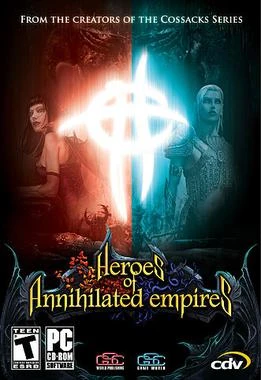
Heroes of Annihilated Empires
 65
★ /10
65
★ /10
 PC
PC GSC Game World

Heroes of Annihilated Empires is one of the most ambitious “what if” experiments in strategy history. Developed by GSC Game World (the Ukrainian developers behind S.T.A.L.K.E.R. and Cossacks) and released in 2006, it was designed as a massive trilogy that would bridge the gap between high-fantasy RTS and third-person RPG.
In the retrospective lens of 2026, it is remembered as a cult classic that was perhaps a decade ahead of its time. It dared to ask: “What if you could play an RTS like a standard Warcraft clone, but also choose to ignore the base-building entirely and play it as a solo action-RPG?” While the planned sequels never materialized, the first chapter stands as a fascinating, slightly janky, but undeniably epic relic of mid-2000s ambition.
The Premise: The World of Luthia
The game takes place on the world of Luthia, a vibrant fantasy landscape populated by Elves, Undead, and mechanical Dwarves. You follow the story of Elhant, a legendary elven ranger. However, the “Annihilated Empires” title isn’t just a cool-sounding fantasy name. The lore subtly implies that this world is actually a post-apocalyptic Earth where magic has replaced technology following a nuclear “Great Disaster.” The clash between ancient magic and forgotten modern-day weaponry is the game’s ultimate (and often overlooked) narrative hook.
Gameplay: The Hybrid Choice
The game utilizes a modified version of the Cossacks II engine, which means it can handle a staggering number of units—up to 64,000 on a single map. The core gameplay is split into two distinct philosophies:
- The RTS Path: You play traditionally. You build a base, manage resources (Food, Wood, Stone, Iron, Coal, and Gold), and churn out massive armies. The scale is immense; you don’t send ten archers into battle, you send five hundred.
- The Hero Path (RPG): At the start of a match, you can choose to sell your “base” and focus entirely on your Hero. Your character gains levels, loots equipment, and learns powerful spells. A high-level Hero can effectively become a one-man army, using screen-clearing spells to evaporate thousands of low-tier units in seconds.
- The Card System: To add even more flavor, the game features a “spell card” system. You can collect and cast over 50 different spells that can summon golems, trigger meteor showers, or buff your massive legions, adding a tactical layer to the real-time chaos.
The Factions: Four Paths to War
The game features four asymmetrical factions, each with its own distinct flavor:
- Sylvan (Elves): The traditionalists. They rely on archers, treants, and dragons. They are fast, hard-hitting, and utilize the forest to their advantage.
- Undead: The “swarm” faction. They can raise fallen enemies to join their ranks, leading to truly terrifying unit counts that can choke an opponent’s CPU (and their defenses).
- Mechanicians (Dwarves): The “Steam-Punk” faction. They eschew magic in favor of zeppelins, steam-tanks, and rifles. They feel like a direct nod to the technological “Annihilated Empires” of the past.
- Cryo-fliers (Solarians): A high-magic faction that utilizes frost-based attacks and flying units, focusing on area-of-effect damage and slowing the enemy down.
The Lost Trilogy
Because GSC Game World shifted all resources to the S.T.A.L.K.E.R. franchise following this game’s release, the story ends on a massive cliffhanger that has remained unresolved for twenty years.
Today, the game is a staple on GOG and Steam, where community patches have fixed the “Resolution Bug” that plagued modern monitors for years. It remains one of the few games where you can experience the sheer, visceral thrill of seeing a single, leveled-up wizard stand his ground against a literal ocean of five thousand skeletons.
Key Features:
- True Hybrid Design — Choose to play a grand-scale RTS or a focused Action-RPG in the same match.
- Massive Unit Counts — Experience battles with thousands of units rendered simultaneously, a feat few games even today attempt.
- Unique Lore — A “science-fantasy” setting where magic and the remnants of modern human technology collide.
- Stunning Art Direction — Beautifully detailed 2D/3D hybrid landscapes and unit designs that have aged gracefully.
- Atmospheric Score — A sweeping, epic soundtrack that captures the melancholy of a world built on the ruins of another.
Release Platforms:
- Microsoft Windows (PC) — Original release in 2006.
- Steam / GOG — Available today as a “Legacy” title, optimized for Windows 10 and 11 via community wrappers.
- Consoles — No console versions exist; the game’s control scheme and unit counts remain strictly tied to the power of the PC.