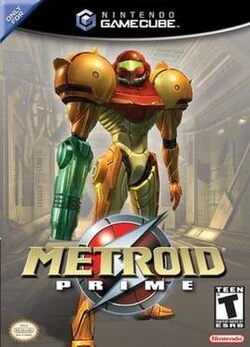
Metroid Prime
 Ninitendo GameCube
 Wii
Wii Nintendo
Metroid Prime is a 2002 first-person adventure game developed by Retro Studios and published by Nintendo. Released in North America on November 17, 2002, for the Nintendo GameCube, it is widely considered one of the most important and critically acclaimed video games of all time. Tasked with the seemingly impossible job of translating the beloved 2D exploration of Super Metroid into a 3D perspective, Retro Studios bypassed the standard first-person shooter formula of the era, creating a deeply atmospheric masterpiece focused heavily on isolation, platforming, and puzzle-solving.
Core Story
You play as the legendary bounty hunter Samus Aran. The game opens with Samus intercepting a distress beacon from the Orpheon, a derelict Space Pirate research frigate orbiting the uncharted planet of Tallon IV. Upon boarding, she discovers the pirates have been decimated by their own horrific genetic experiments using a highly radioactive, mutagenic substance called Phazon. After a violent encounter with her resurrected nemesis, Meta Ridley, an explosion damages Samus’s Power Suit, stripping her of all her advanced abilities.
Following Ridley down to the surface of Tallon IV, Samus finds a beautiful but hostile alien world. She uncovers the sprawling ruins of an ancient, spiritually advanced Chozo civilization that was wiped out decades prior by a poisoned meteor strike. Stranded alone, Samus must explore the diverse biomes, slowly recover her lost power-ups, dismantle the Space Pirate mining operations, and delve into the planet’s toxic core to destroy the source of the Phazon corruption: the titular Metroid Prime.
Gameplay and Features
Retro Studios and Nintendo explicitly rejected the “first-person shooter” label, coining the term “First-Person Adventure” to describe the game’s unique pacing and mechanics:
- The Single-Stick “Tank” Controls: Before dual-stick console shooters became the industry standard with games like Halo, Metroid Prime utilized a unique single-stick control scheme. The left thumbstick handled both moving forward/backward and turning left/right. To strafe, players had to hold the “L” trigger to lock onto an enemy, pivoting the combat into a highly tactical, circle-strafing dance rather than a twitch-aiming shooter.
- Immersive HUD and UI: The game’s user interface was a masterclass in immersion. The HUD is physically framed as the inside of Samus’s helmet. Brilliant touches—like condensation building up near steam vents, static from electrical interference, or seeing the reflection of Samus’s eyes in the visor during bright flashes of light—made players truly feel like they were inside the suit.
- The Scan Visor: A groundbreaking approach to environmental storytelling. By switching to the Scan Visor, players could pause the action to analyze enemy weak points, hack terminals, and read ancient Chozo lore. The game’s backstory is entirely opt-in; you only learn about the tragedy of Tallon IV if you actively choose to scan the ruins.
- The Morph Ball: Transitioning Samus’s iconic ability to 3D was a massive technical hurdle. With the press of a button, the camera flawlessly pulls back into a third-person perspective as Samus rolls into a metallic sphere, allowing players to navigate narrow mazes, solve spatial puzzles, and ride magnetic spider-ball tracks.
- Controller Mapping: The game’s UI was brilliantly mapped to the physical layout of the GameCube controller. The yellow C-stick swapped between your four arm-cannon beams (Power, Wave, Ice, Plasma), while the D-pad swapped between your four visors (Combat, Scan, Thermal, X-Ray).
PC Version
Because Metroid is a marquee first-party Nintendo franchise, the original 2002 game was never officially released on PC. However, the PC emulation community has kept the game incredibly vibrant. Beyond standard emulation via Dolphin, the community created a legendary, dedicated fork called PrimeHack. This customized emulator fundamentally rewrites the game’s code to support modern, flawless keyboard-and-mouse dual-stick controls, custom FOV sliders, and high-resolution texture packs, completely modernizing the 2002 experience for PC players.
Console Versions
Originally a strict GameCube exclusive, the 2002 original received a highly celebrated port to the Nintendo Wii in 2009 as part of the Metroid Prime: Trilogy compilation. This version updated the game to support native 16:9 widescreen and completely replaced the GameCube’s tank controls with the Wii Remote’s IR pointer, allowing for incredibly fast and precise free-aiming.
Decades later, the game was fully rebuilt for modern audiences as Metroid Prime Remastered (2023) for the Nintendo Switch, which modernized the graphics and finally added native dual-stick controller support.
Quick Note
Metroid Prime is a masterclass in atmosphere and level design. It proved that the isolating, map-charting magic of the “Metroidvania” genre could survive—and even thrive—in a 3D space.
In short: Whether you are managing your visors to track an invisible ghost in the snowy Phendrana Drifts or circle-strafing a Space Pirate, the 2002 original remains a flawless blueprint for first-person exploration.