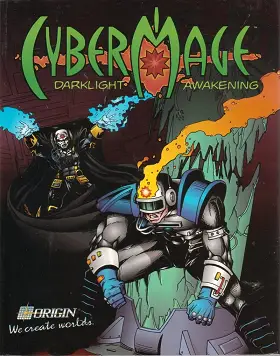
CyberMage: Darklight Awakening
 PC
PC Electronic Arts
CyberMage: Darklight Awakening is a 1995 first-person shooter and action-RPG hybrid developed by David W. Bradley (the legendary designer behind the Wizardry series) and published by the powerhouse Origin Systems. Released exclusively for MS-DOS, it is one of the most wildly ambitious, feature-rich, and tragically overlooked games of the mid-90s “Doom Clone” era. Blending cyberpunk dystopia with dark fantasy magic, it introduced mechanics that wouldn’t become standard in the FPS genre for several more years.
Core Concept and Story
The game wears its comic book inspirations on its sleeve—in fact, the big-box release actually included a physical comic book published by WildStorm (created by David W. Bradley and legendary comic artist Paul Jenkins) to set up the game’s lore.
Set in the dystopian, heavily polluted cyberpunk future of 2044, Earth is controlled by corrupt mega-corporations and ruthless cartels. You play as an unnamed protagonist who is murdered by the forces of NeCrom, a tyrannical, magically imbued dictator who essentially rules the planet. However, your body is recovered by an alien rebel who resurrects you by fusing a crystal called the Darklight Gem into your forehead.
You awaken in a laboratory as the “CyberMage,” a superhero-esque figure who must navigate the neon-lit slums, corporate towers, and mutant-infested sewers to master your new powers and defeat NeCrom (who possesses the rival “Deathbringer Gem”).
Gameplay and Features
While it looked like a standard 2.5D shooter at first glance, CyberMage was stuffed to the brim with revolutionary RPG and immersive-sim mechanics:
- Magic and Tech Arensal: The game featured a brilliant dual-weapon system. You could wield standard cyberpunk firearms (like pulse rifles, rocket launchers, and plasma guns) that required physical ammunition. However, the Darklight Gem in your head also allowed you to cast devastating magic spells (like fireballs, ice shards, and lightning), which drained your regenerating mana pool.
- Driveable Vehicles: This was absolutely mind-blowing for a first-person shooter in 1995. Long before Halo or Battlefield normalized the concept, CyberMage allowed players to seamlessly jump into the pilot seat of heavily armed hover-tanks and flying aircars to navigate massive arenas and wage vehicular combat.
- RPG Mechanics & Economy: Coming from the creator of Wizardry, the game wasn’t just a mindless shooting gallery. You could collect credits looted from enemies and use them to purchase weapons, ammo, and armor from vending machines and merchants. You also had a functional inventory system.
- Friendly NPCs and Factions: Not everything in the game wanted to kill you. You could encounter friendly civilians, neutral mercenaries, and rebels. If you holstered your weapon, you could converse with them to get clues. If you saved citizens from corporate thugs, they would occasionally fight alongside you or drop healing items to thank you.
- Advanced Movement: The engine allowed for jumping, crouching, swimming, and looking up and down—features that the original Doom famously lacked, giving the levels a massive sense of verticality and exploration.
The “Immersive Sim” Precursor
CyberMage occupies a very specific, experimental era of PC gaming alongside titles like System Shock (also published by Origin Systems) and Strife. It was desperately trying to push the FPS genre past simple maze-navigation and into the realm of fully realized, simulated worlds. The concept of wandering a cyberpunk city, managing an inventory, buying upgrades, and choosing between tech or magical augmentations heavily prefigured the legendary design of Deus Ex, which would arrive five years later.
The Sunset and Legacy
Despite receiving generally positive reviews upon release, CyberMage failed to make a massive commercial impact and has largely faded into obscurity.
Its failure to secure a long-term legacy was mostly a matter of incredibly bad timing. It was released in late 1995, and its highly complex 2.5D engine was notoriously resource-heavy, requiring a very powerful PC to run smoothly. Just months later, in early 1996, Duke Nukem 3D arrived with vastly superior attitude and polish, followed shortly by Quake, which completely rewrote the industry standard with true, fully textured 3D polygons. Next to Quake, CyberMage’s sprite-based graphics immediately looked dated.
Quick Note
CyberMage: Darklight Awakening was a brilliant, messy, kitchen-sink game that simply tried to do too much for the hardware of 1995.
In short: If you want to see the fascinating missing evolutionary link between classic Doom and modern RPG-shooters like Cyberpunk 2077 or Deus Ex, this comic-book-fueled adventure of hover-tanks and head-lasers is a remarkable piece of forgotten history.