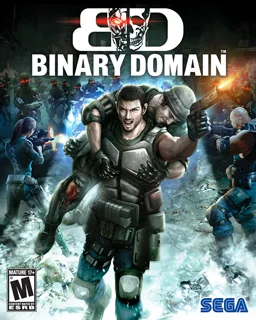
Binary Domain
 74
★ /10
74
★ /10
 PC
PC PS 3
PS 3 Xbox 360
 Ryu ga Gotoku
 SEGA Corporation
Where to buy

Binary Domain is a 2012 sci-fi action-adventure third-person shooter video game developed by Ryu Ga Gotoku Studio and published by Sega. Released in February 2012 for the PlayStation 3 and Xbox 360 (with a Microsoft Windows port arriving later that April), the title stands as a brilliant, fascinatingly unique creative detour for developer Toshihiro Nagoshi and the core creative team behind the legendary Yakuza (Like a Dragon) franchise.
Set against the backdrop of a futuristic, heavily stratified Tokyo in the year 2080, Binary Domain targeted the highly crowded squad-based military shooter market popularized by Gears of War. Rather than offering a generic, run-and-gun clone, the developers infused the title with their signature narrative melodrama, stellar character writing, and two highly ambitious, ahead-of-their-time mechanics: a dynamic voice-recognized squad loyalty engine and a spectacular procedural destruction system for enemy robot logic.
Technical Specifications
| Attribute | Details |
| Developer | Ryu Ga Gotoku Studio |
| Publisher | Sega |
| Director | Daisuke Sato |
| Producer / Writer | Toshihiro Nagoshi |
| Engine | Proprietary RGG Studio Engine (An evolution of the Yakuza 3/4 rendering framework) |
| Platform(s) | PlayStation 3, Xbox 360, Microsoft Windows |
| Release Date | February 24, 2012 |
| Genre | Squad-based third-person shooter, Sci-Fi |
| Mode(s) | Single-player, Multiplayer (Defunct) |
Narrative and Setting
The single-player campaign takes place in Tokyo in the year 2080. Decades prior, catastrophic global warming triggered worldwide coastal flooding, submerging major population hubs and forcing humanity to construct massive, multi-tiered climate-shielded metropolises above the ruins. To supply the staggering labor required to rebuild civilization, advanced Robotics became the dominant global economic industry, split in a bitter trade monopoly between the American titan Bergen and the Japanese powerhouse Amada Corporation.
To prevent AI from completely supplanting humanity, the global community ratified the New Geneva Convention. Its most stringently enforced mandate was Clause 21, which completely banned the manufacture of “Hollow Children”—sentient androids engineered to look, bleed, and pass perfectly as biological humans, completely unaware of their own synthetic nature.
The plot ignites when a rogue assassin infiltrates Bergen’s US headquarters, tearing away his own facial skin to reveal a robotic endoskeleton before detonating himself. The intelligence trail points directly to Yoji Amada, the reclusive founder of Japan’s Amada Corporation.
The Infiltration of the Under-City: Because the isolationist Japanese government completely seals its borders to protect Amada, the United Nations deploys a covert, multi-national black-ops unit known as the “Rust Crew.” Players control Dan Marshall, a cynical, battle-hardened American veteran nicknamed “The Survivor.”
Dan and his fiercely loyal, heavy-weapon-wielding compatriot Roy “Big Bo” Boateng land secretly on the flooded coastal walls of Tokyo. To breach the heavily fortified Upper City where the global elites live, the Rust Crew must navigate the dangerous slum corridors of the Lower City, partnering with an international ensemble including the British tactical commander Charles Gregory, the elite Chinese sniper Faye Lee, and Cain, a highly sophisticated, French-speaking reconnaissance robot sporting a stylish necktie.
Mechanical Innovations
Binary Domain fundamentally subverted the standard “bullet-sponge” enemy conventions of the cover-shooter genre by engineering two highly dynamic gameplay pipelines:
1. The Procedural Dismantlement Grid
Instead of forcing players to mindlessly track health bars, the game utilized advanced real-time physics mapping on enemy mechanical endoskeletons. Scraping away a robot’s armor plating exposed vital wiring clusters, altering their battlefield behaviors based entirely on exactly where they were shot:
- Leg Amputation: Shooting an android’s legs away caused them to violently collapse onto the asphalt, forcing them to desperately crawl toward Dan’s cover while dragging their weapons along the ground.
- Weapon-Arm Severance: Blowing off a robot’s firing arm forced it to dynamically pause, calculate the damage, and awkwardly attempt to retrieve its dropped assault rifle with its off-hand.
- Decapitation (Tactical Hacking): Completely destroying a robot’s head matrix blinded its targeting sensors. Devoid of spatial parameters, the android would turn entirely on its own squads, opening fire on adjacent friendly robots and creating a chaotic distraction for the player to exploit.
2. The Consequence Trust System
The game integrated an active social loyalty engine that governed your relationship with your squadmates. Utilizing either standard controller prompts or an actual live microphone headset interface, players issued vocal orders (“Fire,” “Cover Me,” “Regroup”) and answered personal dialogue questions during quiet lulls between skirmishes.
Teammates continuously judged Dan’s actions based on his battlefield execution and social demeanor. If a player maintained High Trust, squadmates would flawlessly obey orders, suggest unique flanking vectors, and eagerly risk their own lives to drag Dan out of a downed state.
Conversely, if a player consistently shot teammates accidentally, mocked them during conversation choices, or issued suicidal orders, Low Trust would cause squadmates to openly insult Dan, completely ignore his commands, and leave him to bleed out behind cover.
Contemporary Stance
From our current vantage point in mid-2026, Binary Domain is widely celebrated as an untouchable, absolute cult-classic gem of the seventh console generation. While it was a commercial failure at launch due to an underwhelming marketing campaign and stiff competition from mainstream multiplayer shooter behemoths, its critical reputation has grown immensely over the last fourteen years. Following the meteoric rise of Ryu Ga Gotoku Studio into global mainstream superstardom via the Like a Dragon franchise, retrospective circles frequently look back at Binary Domain as a masterclass in cinematic world-building and mechanical audacity.
The software is brilliantly preserved and running in its absolute best technical shape ever today across modern platforms:
The Xbox Series X/S
The title received an immense, definitive preservation boost courtesy of Microsoft’s backward compatibility program. Running on Xbox Series X and Xbox Series S, the game leverages native FPS Boost technology to run at a flawlessly smooth, locked 60 frames per second. Modern hardware effortlessly brute-forces the original software performance caps, completely eliminating the sluggish sub-30Hz dips that plagued original seventh-generation consoles during massive scrap-metal explosions, while modern system-level Auto HDR injects striking vibrancy into Tokyo’s neon skyline.
The Modern PC
On PC via Steam, the title remains fully stable and natively functional under modern 64-bit Windows 11 desktop environments. Contemporary GPUs easily upscale the game’s clean geometry to native 4K resolutions at extreme, un-capped frame rates exceeding 144Hz.
While modern players generally bypass the archaic voice-recognition headset calibration settings in favor of clean, controller-bound squad menus, the game requires zero complex fan-made modifications or wrappers to run perfectly out of the box, preserving the tragic, action-packed mystery of the Hollow Children for a new generation of sandbox and shooter purists.